
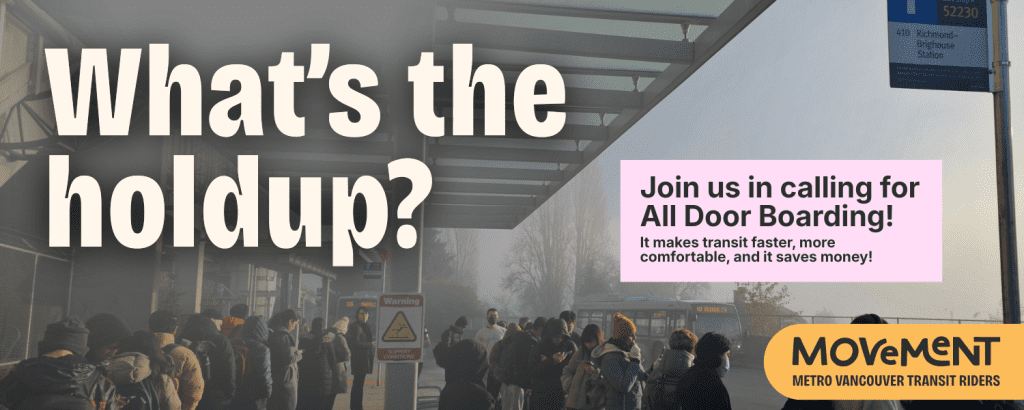
We, the undersigned, call on TransLink to allow passengers to board any bus from any door.
Here’s why:
- It will save passengers’ time. All Door Boarding ensure the bus spends less time at stops, and more time moving. Especially in situations where the wheelchair ramp might be needed, passengers no longer need to wait for that process to complete – they can just walk to the back doors and board there. This also reduces the variability of runtime, which makes the bus more reliable.
- It reduces crowding. Have you ever been on a bus where there’s lots of empty space in the back but everyone’s crowded up front? All Door Boarding could ensure this will never happen again.
- It will save $15 million/year. Transit funding is very hard to come by, but All Door Boarding is easy. Just change a policy, and change a few settings on the bus. Boom – $15 million.
- Those savings can be used to make bus service even better.
$15 million is equivalent to an entire new 99 B-Line. Those savings could be allocated to routes that we know are experiencing overcrowding, or to places with very poor frequencies. Instead, those resources are being wasted while people slowly trundle through the front door. - Lots of cities around the world already allow it.
From Melbourne to Bangkok to San Francisco to Milan, plenty of cities already allow All Door Boarding system-wide. Experts like NACTO have been calling for it for years.
Help spread the word!
Print up some posters and post them to help get the word out about our petition!
Posters are available in Colour and Grayscale Print-friendly versions.
Available in the following languages: English,
*Stewart & El‑Geneidy (2015) estimate that all-door boarding can reduce total running time by 1.8–9.6% on two-door buses and 4.6–13.3% on three-door buses. According the 2024 Transit Service Performance Review, there are 3,435,000 revenue hours per year on routes that currently don’t allow all door boarding, but do have multiple doors. Assuming a very conservative 3% travel time savings, and a conservative $150 operating cost per revenue hour, TransLink could save $15,457,000 per year by implementing all door boarding.