
A Bus Rapid Transit system (BRT for short) is a type of transit service where buses run in dedicated lanes, separated from traffic. BRT lines might also include signal priority to allow buses to skip red lights, upgraded stations with level boarding, off-board fare payment, and other features you would expect to see at metro stations. Because of these extra features BRT lines are usually higher capacity, more frequent, and more reliable than conventional buses.
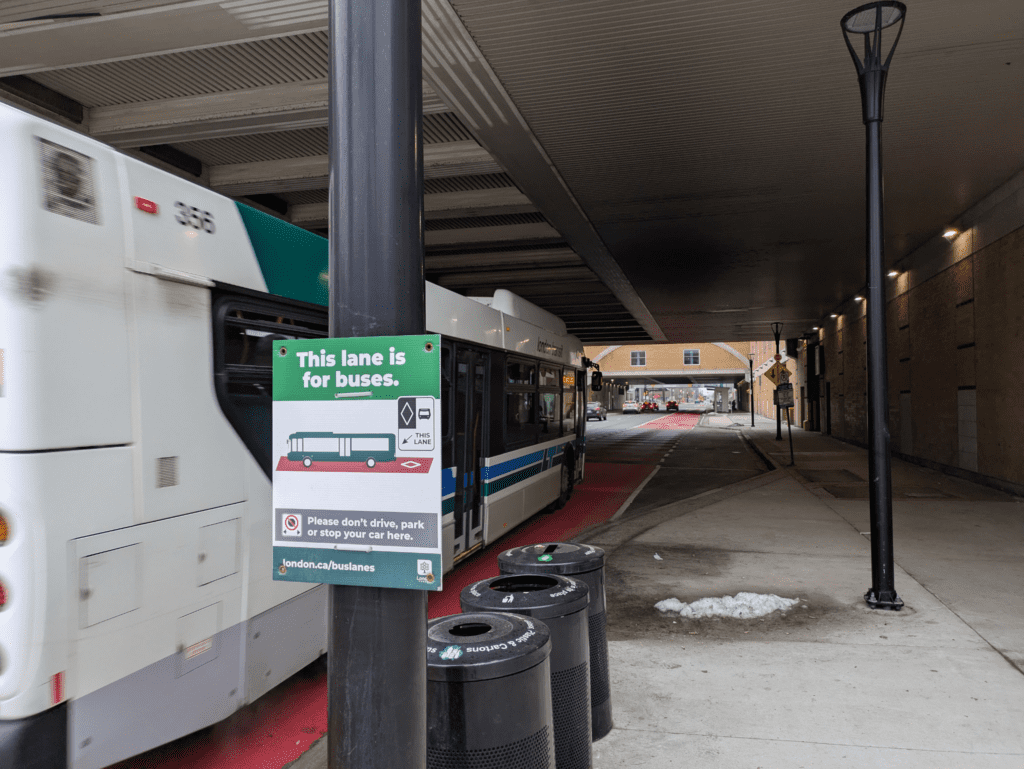
Bus lanes for a BRT in London, Ontario
Compared to building a new rail line, Bus Rapid Transit can be more flexible, lower cost, and faster-to-construct. If done right, BRT is faster, more frequent, and higher-quality than the local buses riders are used to. Bus lanes, signal priority, and high-quality stations mean BRT buses can approach SkyTrain travel times. It’s as close to SkyTrain as our buses can be.
We don’t have any BRT in Metro Vancouver (yet) but there are plans for them, and they’re really common in other cities around the world including: Calgary, London (Ontario), Los Angeles, Cleveland, and Boston.
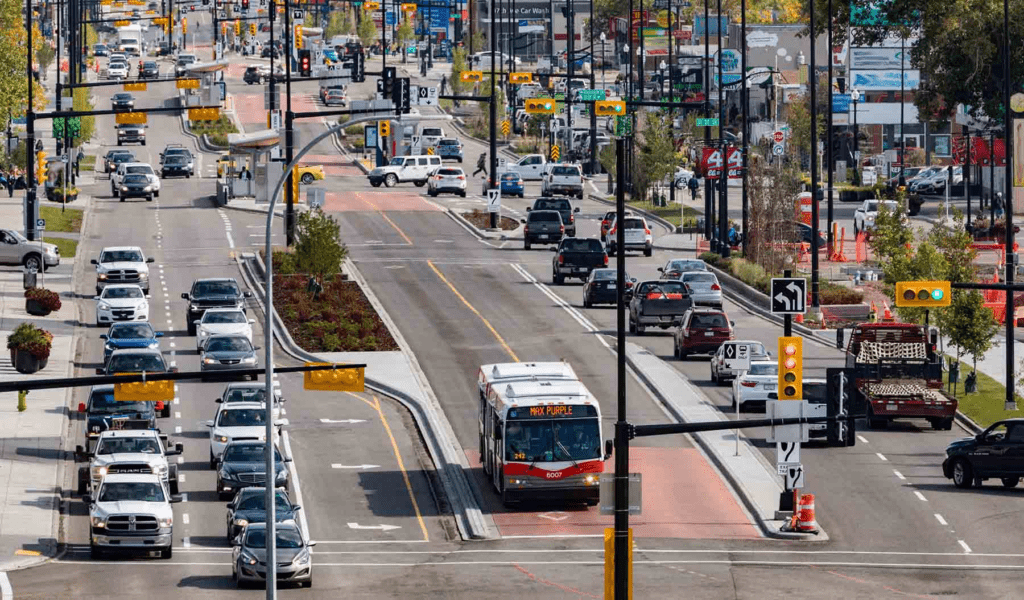
Max Purple in Calgary. Image credit: Stantec
What are the 3 BRTs being proposed in Metro Vancouver?
The 3 BRT routes being proposed connect parts of the city not currently served by SkyTrain. The routes are Surrey City Centre to South Surrey, Langley City to Maple Ridge, and Burnaby to the North Shore.
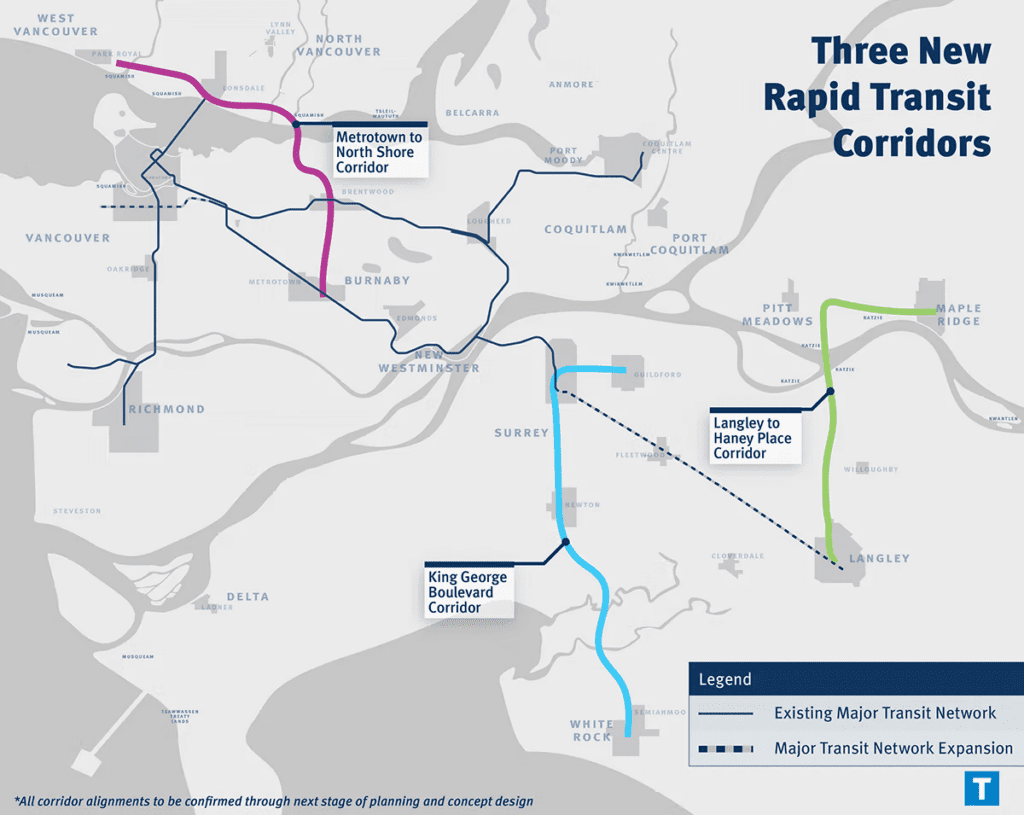
Image credit: TransLink
The first line runs from Surrey Central Station to White Rock Centre along King George Boulevard, largely following the route of the #321 to White Rock Centre. Major destinations include Surrey Memorial Hospital, Bear Creek Park, Newton, and Semiahmoo Mall.
The second line runs from the future Willowbrook SkyTrain station in Langley to Haney Place in Maple Ridge. It will largely run along 200 Street, the Golden Ears Bridge, and Lougheed Highway. Major destinations include the Langley Events Centre, Latimer Heights, Carvolth Exchange, Ridge Meadows Hospital, and downtown Maple Ridge.
The third connects Metrotown to Park Royal. It will run along Willingdon Avenue, Hastings Street, the Ironworkers Memorial Bridge, and follow the current route of the R2 RapidBus to Park Royal. Major destinations along the way include BCIT’s Burnaby campus, Brentwood, Burnaby Heights, Phibbs Exchange, Lower Lonsdale, and Capilano Mall. The routing of the BRT line between Brentwood and Burnaby Heights is still undecided, but we know which one we prefer!
What is the status of the BRT lines?
TransLink has done lots of consultation and engagement with the public on BRT, but the details of the routes are still unknown. We don’t know exactly how much of the BRT routes will be separated from traffic or sharing the road with cars, or if there will be any transit signal priority.
In Burnaby, we still don’t know which route it will take. The recently announced R2 extension will run along Hastings and Willingdon, and the BRT is supposed to share most of its route with the R2, but it might not follow the exact same route. Burnaby City Council will vote on the two possible routes at some point this year, and TransLink is supposed to release a report about the consultation conducted in fall of 2025.
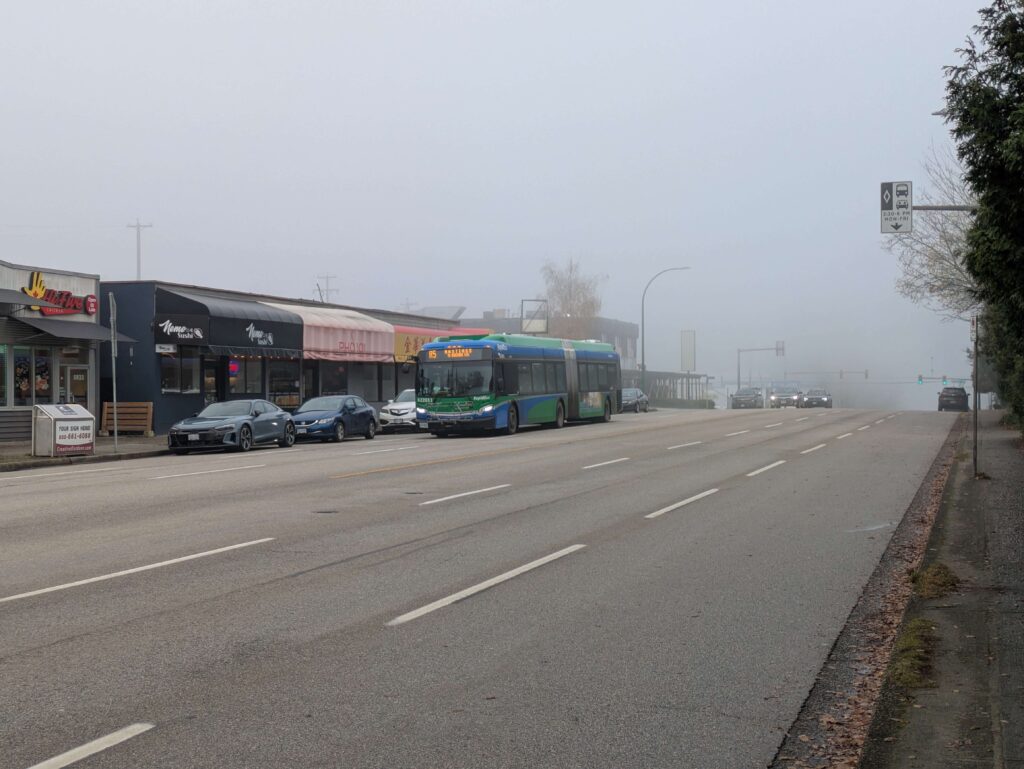
The R5 RapidBus on Hastings Street
There’s a broader risk that these BRTs may never come to exist. Right now they only exist as plans, and have no set funding for construction or operation. This is because transit funding in Metro Vancouver is in a perpetual crisis. Back in the Spring of 2025, thanks in part to our advocacy, the province and mayors came to an agreement to fund transit. However this will only fully fund transit until 2027. After 2027, the province needs to implement a new funding tool to keep service going. If we want major transit improvements like these three BRTs, this funding tool needs to provide more than the bare minimum, and the federal government will also need to step up to fund them.
How can transit riders in Metro Vancouver influence the BRT lines?
We are really looking forward to BRT in Metro Vancouver! But only if it goes to the places people want to go, has good transit priority measures, and runs frequently. If it isn’t a major improvement over existing transit services, few people will ride it. It’ll just be used as an example of what not to do again, like the BRT in Calgary. That BRT is a victim of a phenomenon known as “BRT Creep” where a BRT is planned, but due to political pressure, it gets watered down until it is little better than the service in place today. Calgary’s BRT ended up being slower, in some cases, than the local bus route it replaced, and only comes every 20-30 minutes. This is despite spending $180 million on its construction. Transit supporters like you will need to play a big role to ensure our BRT corridors don’t repeat Calgary’s mistakes, and Movement will be here to help you speak up. (Don’t forget to sign up for email updates if you haven’t already!)
Transit riders like you can email your representatives to let them know you’re excited for the BRT and that you hope they make sure it happens. They are more likely to hear from opposition, so hearing support for these projects matters a lot. Let them know how existing transit service does or doesn’t meet your needs, and how a faster, more reliable bus might make a difference in your community. We’ve provided an example message below, but feel free to edit it as you like!
To find your mayor and council, search for the name of your city + mayor and council contact information.
- You can enter your postal code here to find your MLA (provincial representative).
- And your MP (federal representative) can be found here.
Subject: Fast and reliable BRT won’t happen without your leadership
Dear Mayor _, Councillors, MLA _, and MP _,
Public transit is of great importance to me. I’m really excited about the plans to make three new Bus Rapid Transit routes in Metro Vancouver – they will make accessing all corners of our region without a car so much easier.
However, I’m worried that these BRTs will never actually exist. We need the provincial government to follow through on its promise to make a new funding tool to adequately fund and expand transit, and we need the federal government to commit to funding major transit projects.
I’m also concerned that the BRTs won’t have as much transit priority as they need to truly put the R in BRT. We need municipal government mayors, councillors, and staff to designate lanes for these buses only and to support the implementation of traffic lights with transit signal priority. Without these priority measures, the BRT won’t be any better than our existing bus network.
Thank you,
[your name]
[your address]