
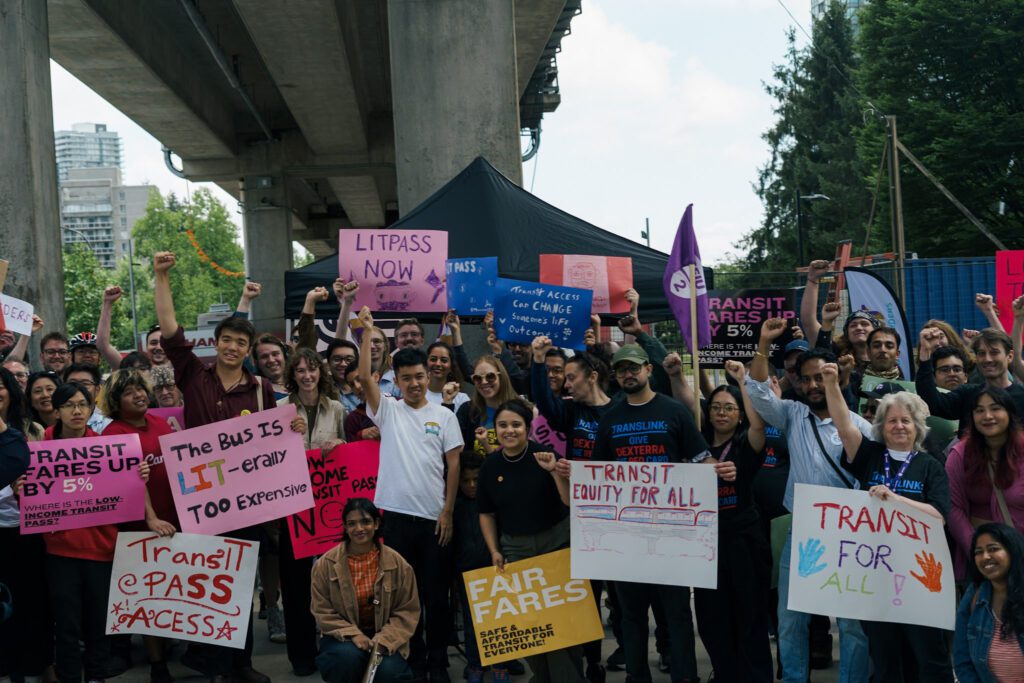
Update (July 28): Transit fares increased on July 1, and we hosted a rally attended by over 200 people. There was significant media coverage on this campaign, but we have not yet heard from the province. We need to keep the pressure on. If you have not already, please send an email to your MLA.
Vancouver, Langley City, Port Moody and Burnaby have already passed motions supporting a low-income transit pass.
On July 1, TransLink implemented another 5% fare increase, making life for Metro Vancouverites even more expensive.
This new fare hike in July added another $120 per family member to household expenses each year. The cost of living here is already the highest in Canada, and another increase this July has only deepened the financial strain on workers, families, and low‑income riders.
No one should be denied transit because they can’t afford it.
Metro Vancouver is one of the few regions in Canada without a discounted transit program for low‑income youth and working‑age adults. We’re calling on the provincial government to expand the BC Bus Pass program to include all low‑income people and to stop punishing riders with unjust fare hikes.
Read our op-ed about the LIT pass in The Tyee.
Send a letter to your MLA for a low-income transit (LIT) pass.
Email or meet with your provincial representative (MLA).
Attend our rally on July 1 from 12-1:30 pm at Metrotown Station.
How else can I help support a Low-Income Transit pass?
Meet with your MLA
Sending an email to your MLA is a great start, but taking the time to meet with them is even more impactful. Your MLA is your provincial representative, and they work for you, regardless of your voter status and whether or not you cast your vote for them. A big part of their job is to meet with constituents (people who live in their area) and listen to their concerns. They can then bring that concern to the relevant part of the government or bring forward new legislation that would address the concern.
To meet with your MLA, call or email their office and ask to set up a meeting, and let them know that you’d like to meet with them about a low-income transit pass. We have some materials linked here to help guide you through the meeting, and a leave-behind sheet with some extra information that you can print out for the meeting and provide to your MLA and their staff. You don’t need to have all the numbers and knowledge about this policy, what’s really powerful is to share your story of how a low-income transit pass would change your life, or your friends’ and family’s lives.
Email us at hello@movementyvr.ca with any questions, or to set up a meeting with us about meeting with your MLA! We’re here to support you.
Attend our rally on July 1 from 12-1:30 pm at Metrotown Station.
Spread the word. Share our social media posts, download posters to put up in your community.
Isn’t there already a low-income pass?
The BC Bus Pass is only for low-income seniors and persons with disabilities; it does not cover low-income, non-senior individuals. We are advocating for a discounted pass for ALL low-income people.
Is this actually achievable?
Yes, totally! We already have the building blocks of this program through the BC Bus Program described above; expanding this program to include all low-income people would be easy.
TransLink staff recommended a low-income discount to the Mayors’ Council that would cost $70 million yearly (just for Metro Vancouver)
Who would be responsible for implementing this? And is this just for Metro Vancouver or for all of BC?
The BC Bus Pass Program is administered by the Province of British Columbia, specifically under the Ministry of Social Development and Poverty Reduction. While it is a province-wide program (and we ultimately want to see it expanded to include all low-income residents across BC), our focus is on Metro Vancouver, where we represent transit riders and are facing upcoming fare increases in July.
At the same time, we are committed to working with transit advocates across the province to achieve this goal collectively. Several cities are already taking action to improve affordability: Kamloops has recently implemented a low-income transit program, and Penticton offers free transit to all residents under 24.
How would people apply for the program?
Those eligible for the BC Bus Pass Program (such as Indigenous Elders and newcomer seniors in Surrey) have told us the application process is confusing and intimidating, and many are unaware that the program exists.
We are calling for a simpler, more accessible process, including clearer communication and fewer administrative barriers. Like Edmonton’s model, access to a low-income transit pass should be integrated into places where people already receive support, such as discounted recreation, social housing, or income assistance, so people can access it more easily.
Why are we not advocating for free transit?
The LIT Pass is a fight we can win, bringing relief to the people who need it soon, not eventually.
Here’s why: 1. Most other cities already have a LIT pass; even Calgary. It’s embarrassing that we don’t, and that makes it an easier sell to provincial politicians from any party. 2. It doesn’t cost very much to implement – about $70 million/year.
There are lots of different groups calling for different levels of affordability, which is great because the more people telling the province that transit affordability is a problem, the better! Together with other groups, we can shift the discussion so that the status quo is no longer acceptable.
How is the campaign progressing?
A lot has been happening! Vancouver Councillor Orr brought forward a motion on June 3rd in support of the LIT pass, it was amended and passed unanimously! More about that in our press release.
Over 2,000 people have emailed their MLAs in support of a LIT Pass! And many organizations have signed on to show their support.
Our call has been featured in the media: The Vancouver Sun, CBC, CityNews and Vancouver is Awesome have all covered it!
Coalition List
- Afiya Care Collective
- Back in Motion
- BC Nurses’ Union
- BC Policy Solutions
- BC Poverty Reduction Coalition
- Better Transit YYJ
- Bici Libre
- Burnaby Citizens Association
- Canada-Philippines Solidarity for Human Rights
- Canadian Association of Physicians for the Environment BC Committee
- Carnegie Housing Project
- CEED Centre Society
- Climate Recentered
- COPE Vancouver
- Coordinated Community Response Network (CCRN)
- Council of Senior Citizen’s Organization of BC
- Disability Justice Network of British Columbia (BC)
- Distro Disco
- Downtown Eastside Arts and Crafts Society
- Elizabeth Fry Society of Greater Vancouver
- Gurdwara Dukhnivaran Sahib Society
- Hua Foundation
- Hospital Employees’ Union
- Live Educate Transform Society
- Mela City
- Migrant Students United Vancouver
- Mission Possible
- Moving Forward Family Services
- New Westminster Downtown Residents Association
- New Westminster & District Labour Council
- New Westminster Tenants Union
- OneCity Vancouver
- Project Arrowroot
- Salam Central
- SEIU Local 2
- Shake Up The Establishment
- Solid State Community Society
- South Granville Seniors Centre
- South Vancouver Neighbourhood House
- The Cleaning Cooperative
- UBC Social Justice Centre
- Vancouver – Canadian Students for Sensible Drug Policy
- Vancouver District Labour Council
- Vancouver Food Justice Coalition
- Vancouver Neighbourhood Food Networks
- Venue Co-op YVR
- Vision Zero Vancouver
- Vines Art Society
- Wildfires Bookshop
- Weaving our Worlds
- Women Transforming Cities