
FOR IMMEDIATE RELEASE
January 2nd, 2025
Movement will be riding the first ever mid-day trip of route 80 in the River District.
● Available for interviews before, during, and after the ride
VANCOUVER – On Monday, TransLink is rolling out increased service on dozens of routes across Metro Vancouver. This is thanks to new funding that was agreed upon in TransLink’s 2025 Investment Plan, which Movement pushed hard for.
This increased bus service will be a game changer for the neighbourhoods that rely on those routes. And this is just a glimmer of what becomes possible when funding is made available for transit expansion.
In this press release, Movement will go into detail about who benefits from these changes, which ones are the most impactful, where the funding came from, and how we can get more of it.
To celebrate these changes, a few Movement volunteers and staff will be riding the very first mid-day trip of Route 80, serving the long-neglected River District. Media & elected officials are invited, and interviews are heartily welcomed.
Monday, January 5, 2026
Media avail from 9:00am
We will catch the 9:27am bus departing here for Marine Drive Station
3479 W Sawmill Crescent, Vancouver
in front of Orange Theory Fitness
Media contact: Denis Agar, 778 776 8806
The River District finally has an all-day connection to the Canada Line
The River District has existed for over a decade with almost no link to a SkyTrain station in Vancouver (They previously had route 31, which links only to Metrotown in Burnaby. For River District residents trying to travel towards downtown and UBC, the Metrotown connection took them out of their way, and resulted in an unnecessary 2-zone fare). In 2023, Route 80 launched thanks to the savings generated from TransLink’s Bus Stop Balancing program. Residents finally got a link to Marine Drive Station, but only in peak times. On Monday, this route will be extended to run every 30 minutes on weekdays from 6am to 6:30pm. We’ll be on the very first mid-day trip to celebrate (see above for details).
This route not only serves the River District, but offers a boost in capacity along the most crowded parts of Route 100, serving Marine Drive between Cambie St. and Kerr St.
We’ll keep pushing for evening and weekend service on the 80, as well as more frequency and a north-south connection from River District to their catchment schools in Killarney. We’d also like to acknowledge MLA George Chow, who often speaks of the importance of transit to the River District.
We will finally have 24-hour service to the airport
The hours of route N10 will be extended to finally fill the nighttime period when the Canada Line does not run. This is a long overdue step, and will be a game changer for the thousands of people who work at YVR. Unfortunately, there are still many people and workplaces that are out of the reach of our night bus network (PDF map) which pales in comparison to Montreal or Toronto. We’ll be pushing for 24-hour access to neighbourhoods like Newton next.
Neighbourhoods across the region will have earlier and later service
TransLink will be extending the hours of operation on a wide swath of routes across the region. This is good news for shift workers who may have had to either buy a car or rely on taxis because transit didn’t previously serve them.
These routes have seen some of the biggest improvements in hours of operation:
- Coquitlam – Burke Mountain – Route 191
- Delta – From Ladner to Scottsdale – Route 310
The last bus between South Delta and North Delta is now later – about 9:30pm, but that isn’t late enough. This highlights how much work remains to ensure truly late-night service across the region. - New Westminster – 8th Ave – Route 128
- Surrey – Bear Creek – Route 325
- Surrey – Southeast Newton and Fleetwood – Route 341
- Vancouver – West 16th and east 33rd – Route 33
COVID-era service cuts are starting to be undone
Vancouver’s trolleybus routes were cut to the bone during COVID (to reallocate service to crowded routes in Surrey), and the proposed changes to Route 16 is a glimmer of hope that they’ll start to come back. The region’s 5th busiest bus route used to come every 8 minutes midday, and now it’s 15. Starting on Monday, it will be back up to 12. We want to see previous service levels restored on the 16, as well as on other heavily cut routes, like the 20, R5, and 406.
Route 555 is a superstar route with only three stops, linking a park-and-ride in Langley with the SkyTrain. It is the fastest route in the region, and the 8th most cost-effective. It used to come every 6 minutes in peak times, then down to 12, and on Monday, back up to 10.
Our most crowded routes are getting targeted relief
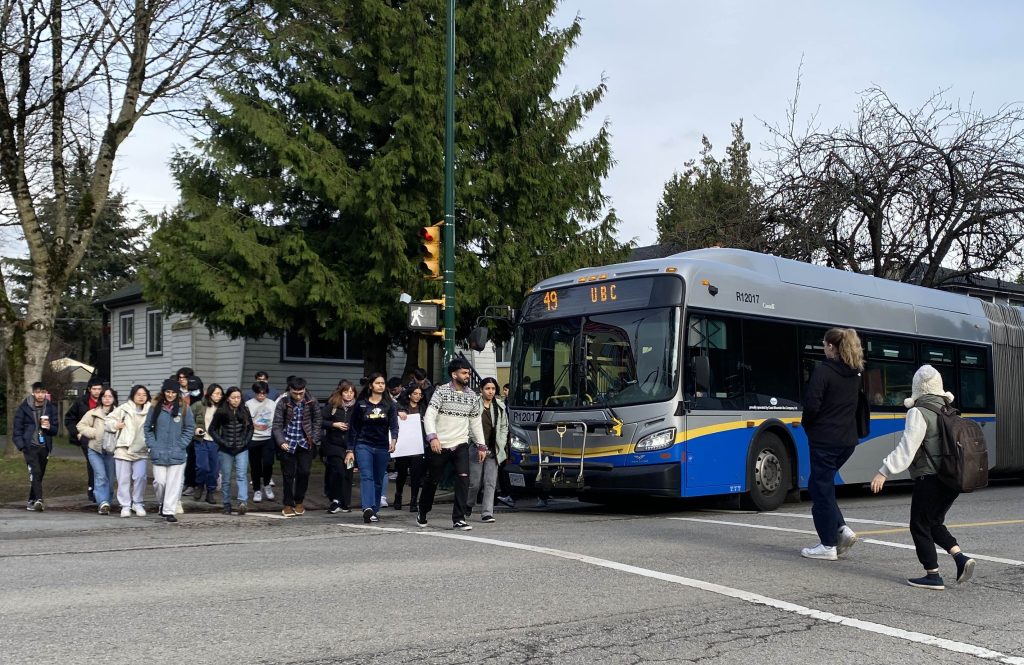
Route 49 is the route that keeps on growing. Running along 49th Avenue through South Vancouver, it has rocketed up the charts to become the region’s busiest local bus route (only the R4 and 99 rapid routes have more riders). TransLink is boosting capacity *again*, but it’s time to start talking about a RapidBus on this corridor. TransLink’s plans mention this concept, but it will take action from both them and the Cities of Vancouver and Burnaby to implement bus lanes. Vancouver council committed to bus lanes on this corridor before the end of 2026, but quietly pushed this project until after the municipal election.
Route 335 on 108 Ave in Whalley and Guildford, Surrey will also see long-needed capacity boosts.
Shorter wait times on infrequent routes
Frequency is the most important factor in attracting new riders to transit. New West’s two east-west routes – 128 and 155 – will be upgraded to 30-minute frequency all day, every day until midnight. Also, the only bus to Fort Langley – Route 562 – now runs every 20 minutes all day on Saturdays. 12- or 15-minute frequency is the threshold where ridership really starts to take off, and we want to see far more routes across the region reach that level.
Higher capacity for high school trips in Coquitlam, Surrey, Langley
Since most school districts have ended school buses, many high schoolers rely on public transit. On Monday, capacity will be boosted at school commute times on eight routes, so that students aren’t forced to cram into a crowded bus or wait for the next one.
This is just the beginning. More funding can change lives!
We’ve only mentioned 15 routes, but there are 37 in all that will be seeing incremental improvements. In the 2025 Investment Plan, TransLink was provided funding to expand bus service by 5%, and by Monday, 1.7% or about a third will have been implemented. That means we can expect more good news in the April, June, and September service changes.
But the need in this region is far greater than a 5% increase. The population alone has increased 15% from 2019 to 2024, and transit increased 0% in that time. TransLink’s own plans call for a 100% increase over 10 years, or about 10% per year.
Transit activism works. These changes are as a result of heavy campaigning from Movement last spring. The province promised a stable funding stream for transit by 2027, and we’re being proactive to make sure that funding stream becomes a reality.
This past fall, we hosted Transit’s Next Top Funding Model, where teams pitched their idea to generate transit funding. Two winners were chosen: the judges chose a sales tax, and the audience chose a vehicle levy. This funding will be overwhelmingly popular, as is seen in other cities. In the last five years, 86% of the transit tax referendums have succeeded in the United States, from North Dakota to South Carolina.
In 2026, we’re going to use what we learned last year to go even bigger. We’ll be working with riders in neighbourhoods across the region to highlight the improvements they want to see in their community, and how we can make those a reality.
How were these improvements paid for?
The expansions in TransLink’s 2025 Investment Plan were funded by the following:
- Fare increases of 5% in 2026 and 2% in the following years, as well as a $1.50 increase to the YVR Addfare.
- Our region is one of the only ones with no fare discounts for adults with low incomes. That’s why we’re pushing for enough funding to cover a discount, similar to our peers.
- Increases to the TransLink property tax in 2025 and 2027
- An increase to the parking sales tax from 24% to 29%
- A $312 million contribution from the province, along with a commitment to introduce a sustainable long-term funding tool.
What additional investments does Movement want?
Over the course of 2026, Movement will be working with riders to identify which changes would be most transformative in their lives. We expect the list to include:
- A deep fare discount for adults with low incomes
- The elimination of overcrowding and passups on the region’s busiest bus routes, and on SkyTrain
- Reinstatement of frequency on all routes that have been cut back since 2020
- RapidBuses on major corridors across the region
- Express routes to shrink travel times for long trips
- Major Rapid Transit investments like SkyTrain to UBC and Gondola to SFU
- Frequent all-day service to every corner of the region
- A major expansion of NightBus service
- Dedicated transit lanes on streets and provincial highways, along with traffic signal priority and automated bus lane enforcement
- New routes to neighbourhoods that are underserved by transit
- Modern bus route management techniques to improve on-time performance
Movement: Metro Vancouver Transit Riders is a non-profit that represents our region’s one million transit riders. We’ve often been left out of the conversation, and we’re here to speak up for faster, more reliable, more abundant transit. We’re focused on the growing number of bus routes where riders are left behind by full buses, day after day, primarily in Surrey and South Vancouver, as well as the urgent need for bus lanes that cost almost nothing but massively improve commutes for hundreds of thousands of people.
Media Contacts:
Denis Agar
Executive Director
778-776-8806
denis.agar@movementyvr.ca
http://movementyvr.ca
Movement: Metro Vancouver Transit Riders
200-475 W Georgia St.
Vancouver BC
V6B 4M9