
TransLink and the BC Government are investing billions of dollars on multiple SkyTrain projects in Metro Vancouver to shorten travel times and alleviate worsening congestion on our roads.
At the same time, there is a glaring rapid transit gap holding our region back that could be fixed for a fraction of the cost and completed in just a few years, instead of the billions and decades needed for SkyTrain.
This gap is the complete lack of east-west rapid transit from Richmond.
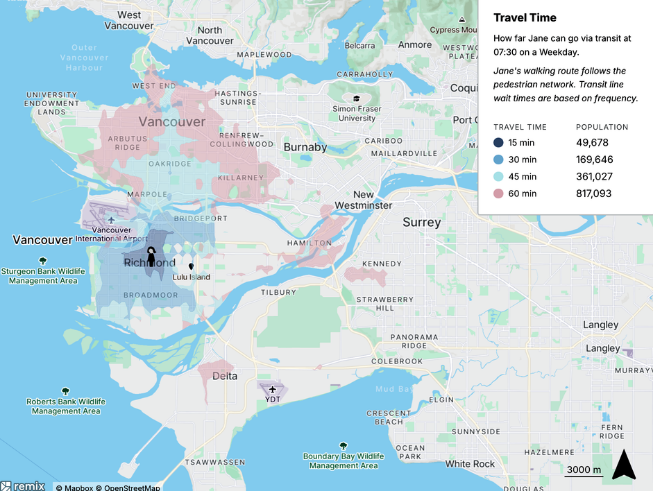
The coloured blobs on this map show where you can get to on transit from Richmond in 60 minutes. Poor east-west transit options mean that trips eastward to Burnaby and Surrey take far longer.
Why East-West Trips Suck So Much Today
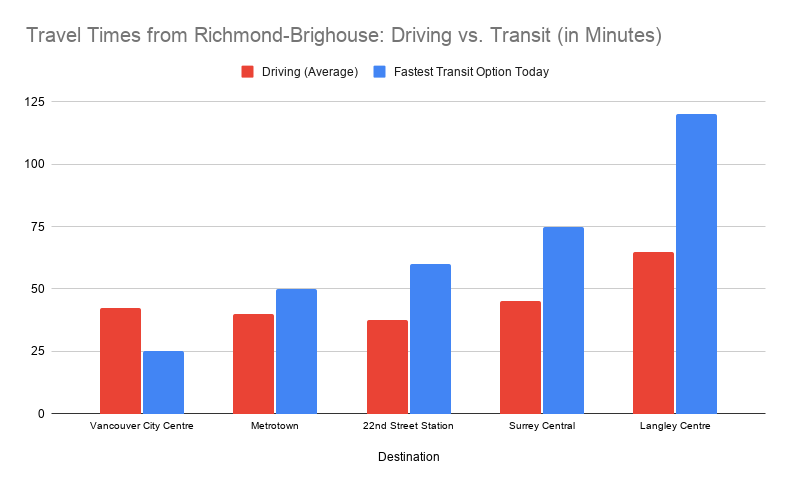
Those trying to get from Richmond’s City Centre to Metrotown, New Westminster, and Surrey Central, and beyond are forced to choose between three bad options.
Option 1: Bus
The 410 to 22nd Street Station or 430 to Metrotown both take around an hour one way. They are direct, but slow and unreliable, with 20-28% of trips being delayed by traffic, especially over the Knight Street and Queensborough Bridges.
Option 2: SkyTrain via Downtown Vancouver
This route is far more reliable, since SkyTrains do not get stuck in congestion. Nonetheless, it’s far from perfect.
Aside from worsening existing already-crowded SkyTrains, the indirect route means that it takes almost as long as the buses while costing more, with the added cost of crossing zones on SkyTrain.
For those Urban Centres that are located… on different rapid transit lines [e.g., Richmond and Metrotown]… the travel time is significantly slower on transit.
TransLink, 2019
Travel from Metrotown to Richmond […] is much slower by transit, despite these two locations having access to the rapid transit network For this particular trip, the fastest way to travel is to transfer from Canada Line to Expo Line (or vice versa) in Downtown Vancouver.
Option 3: Driving
Congestion makes the drive just as unpredictable as the bus ride. As the region’s population grows, our roads will only become more congested as bad transit options force more and more people to choose driving.
This option is also the most expensive, with a single car costing a family in Metro Vancouver an average of $13,798 per year. Driving is simply not an option for those living on lower incomes amidst our cost-of-living crisis.
We need fast and reliable transit for Richmond’s east-west trips
This doesn’t need to take decades of planning and billions of dollars to build. It only requires our leaders to build upon the decades of success of highway express buses in BC.
Movement: Metro Vancouver Transit Riders, a non-profit transit advocacy group in the region, has put forward a proposal that does exactly that. So what’s the solution?
A new highway express bus route between Richmond-Brighouse and 22nd Street Stations running on Highway 91 with transit priority.
Highway 91 Express (91X)
The 91X would cut the trip length down to just 20 minutes.
Thanks to transit priority measures, the 91X could be the fastest option for trips between Richmond and Metrotown, New Westminster, and even Surrey Central, slashing travel times by 40-67%.
Yes, even faster than driving!
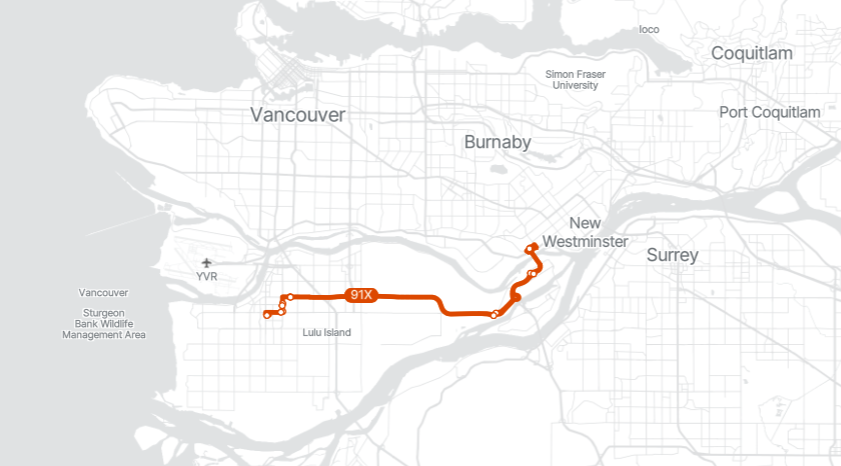
Proposed express highway bus route.
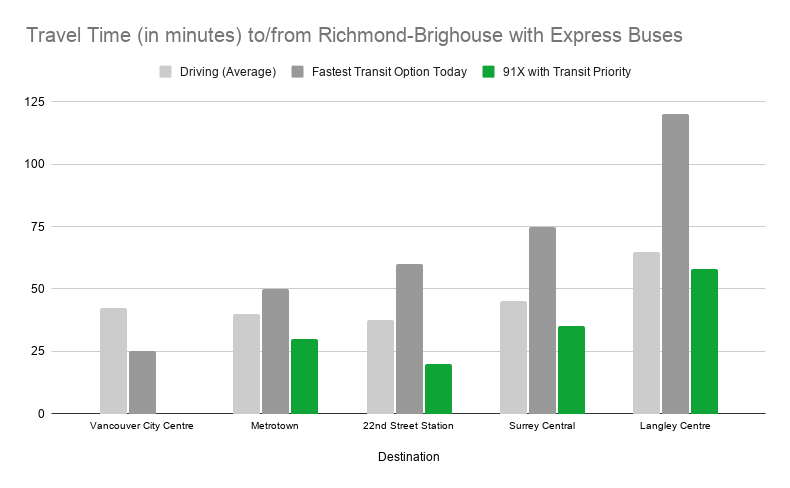
Transit times from Richmond-Brighouse to key regional destinations
| Destination | Transit Time Today | Transit Time with 91X and Transit Priority | Time Savings |
| Metrotown | 50 minutes | 30 minutes* | 20 minutes |
| 22nd Street Station | 60 minutes | 20 minutes | 40 minutes |
| Surrey Central | 75 minutes | 35 minutes* | 35 minutes |
| Langley City Centre | 120 minutes | 60 minutes** | 60 minutes |
* with a connection on the Expo Line
** with the Surrey-Langley SkyTrain
91X would transform our region
- Trips on this route would be faster by transit than driving
- This project would have the same effect as SkyTrain, but for a fraction of the cost
- With 91X being faster than driving, current drivers would switch to taking transit and take thousands of cars off our roads, making space for those who need to drive (e.g., truckers and emergency vehicles).
- Round trips between Richmond’s Downtown, Hamilton, New Westminster, North Delta, Surrey, and beyond would be 80+ minutes faster
- Richmond, Burnaby, New Westminster, North Delta, and Surrey residents will have fast and reliable access to hundreds of thousands of jobs and educational opportunities
- Employers would gain access to a wider talent pool
- Residents of the Hamilton and Queensborough neighbourhoods would no longer be isolated by geography and long travel times to their respective cities.
- Families across the region would save tens of thousands of dollars every year by not needing a car / as many cars.
- The Canada and Expo Lines, with fewer trips needing to be made via Downtown Vancouver, will be less busy, accommodating the ridership growth expected with the extensions of the SkyTrain on Broadway and into Surrey and Langley.
- Amidst international trade uncertainty, our region would be more resilient and integrated, with ripple effects throughout the province and country.
This is a rare opportunity to improve regional mobility for so many in the region and can be completed in a few years—a fraction of the time and cost of SkyTrain.
Without this rapid transit connection, our fast-growing cities remain disconnected while congestion brings our region to a standstill.
How can this bus be so FAST?
- Express Highway Routing
- Bus-on-Shoulder Lanes
- Metering
- Transit Signal Priority
- Bus-Only Queensborough Bridge Onramp
1. Express Highway Routing
This would not be operated as a regular bus route. It would make only five stops on its 19-kilometre trip, and travel on mostly freeway! 22nd Street Station’s close proximity to Highway 91 means the 91X spends less time on slower local streets.
We already have several similar routes operating in the TransLink network:
- 351 Bridgeport Station / White Rock Centre via Highway 99 (47 km/h)
- 555 Lougheed Station / Carvolth Exchange via Highway 1 (65 km/h)
- 620 Bridgeport Station / Tsawwassen Ferry Terminal via Highway 99 and Highway 17A (46 km/h)
2. Bus-on-Shoulder Lanes
Around the world, Bus-on-Shoulder lanes are a tried and tested way to cost-effectively get transit moving faster than cars. It is exactly as it sounds—the existing shoulder lane is converted into a bus-only lane. In some places, the shoulder can be widened, while in others, the lane lines are moved to make room for it.
The result? Buses can bypass congestion, allowing for fast and on-time service, even during rush hour. Bus-on-shoulder lanes leverage existing infrastructure, meaning that we can get incredible speed and reliability much quicker and more affordably than SkyTrain.
The BC Ministry of Transportation and Transit (MOTT) can take credit for some existing Bus-on-Shoulder lanes that work extremely well.
The most prominent example is the bus-on-shoulder lanes on Highway 99 in Richmond and Delta.
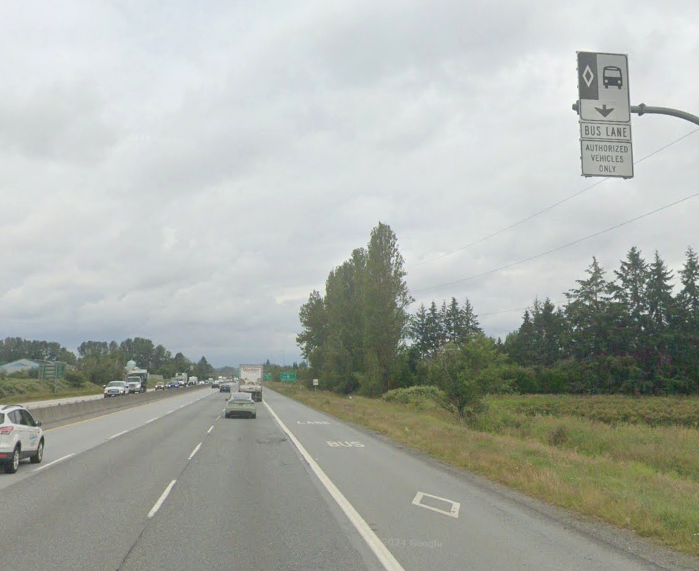
Northbound bus-on-shoulder lane on Highway 99 in Richmond. Source: Google Maps
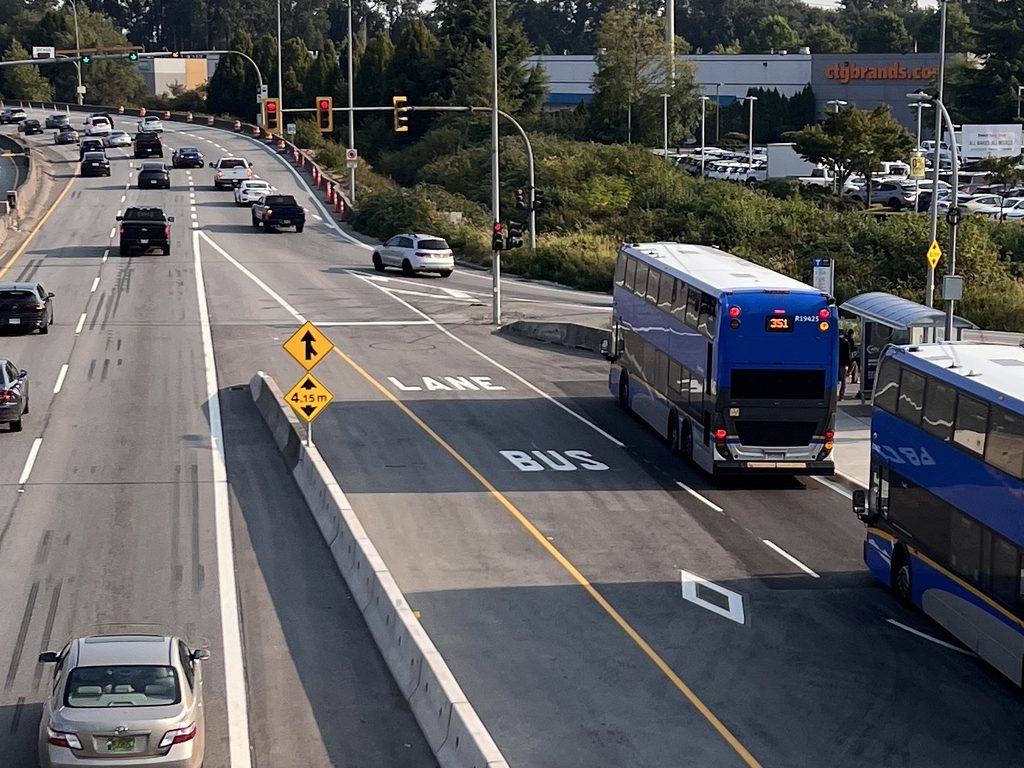
Bus lanes on Highway 99 at the Steveston Highway Interchange.
Dedicated lanes and express buses on Highway 99 mean that transit beats driving for many trips north from Ladner, Tsawwassen, and White Rock.
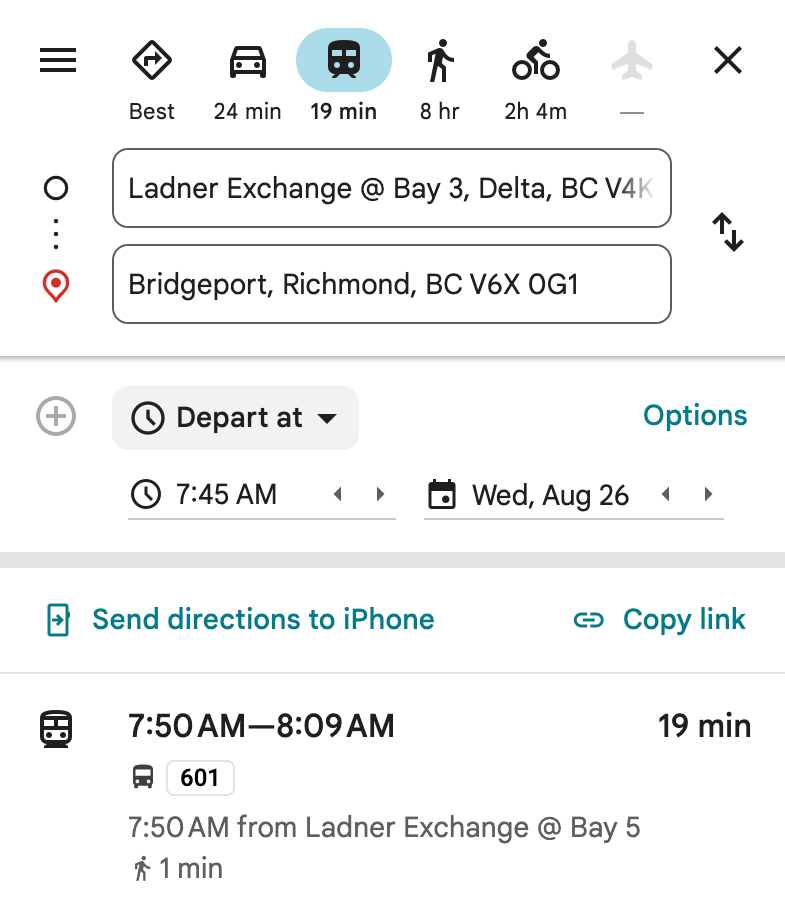
The magic of bus-on-shoulder lanes is that buses get a clear path without taking an existing lane away.
Highway 91 is a Provincial highway, meaning that the BC Government can add bus-on-shoulder lanes to the freeway without lengthly negotiations with local and federal governments.
Bus-on-shoulder lanes are cheap!
In 2023, the BC Government added bus-on-shoulder lanes to 6.4 kilometres of Highway 99 in Delta. At a cost of just $12.8 million, the project is incredible value for money.
At this price, one kilometre of bus-on-shoulder lane in both directions for this project cost just $1.52 million, a mere 0.41% the per-kilometre cost of the Surrey-Langley SkyTrain.
The BC Government could start technical design on this project today, and likely finish within a year!
3. Metering
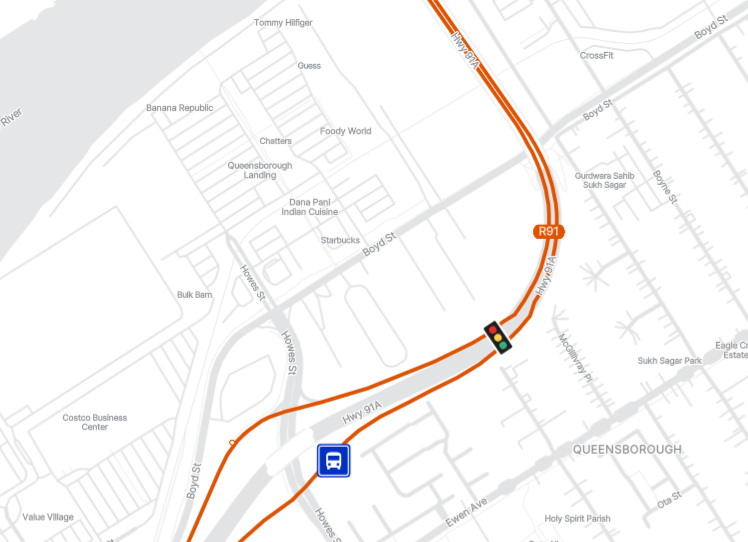
Metering of Highway 91A in Queensborough.
The Queensborough Bridge is the main bottleneck on this corridor. Widening the bridge would be a decade-long multi-billion dollar project, and might actually shift the problem into residential neighbourhoods.
Instead, if we slightly limit the number of cars on the bridge at peak times, we can shift the congestion to a place where buses can bypass it. Car drivers get to their destination in the same amount of time as before, and they gain a fast reliable alternative that didn’t exist before.
Ramp metering achieves this outcome at similar pinch points like the Lincoln Tunnel to New York and the Bay Bridge to San Francisco, or on ramps to I-5 in Seattle. It involves installing a traffic signal on the approach to the bridge. It would only turn red when needed to ensure traffic flows smoothly on the bridge. When a bus is detected as approaching using the bus lane, it would get a green automatically.
Wouldn’t this just worsen traffic on Highway 91?
No.
The same number of vehicles will end up crossing the bridge; they’ll just be stuck in traffic while on land instead of on the bridge. They’ll also find that they now have a new transit alternative that could save them serious time and money. The bridge will also be clear for emergency responders who may end up being able to save lives in Queensborough as a result.
4. Transit Signal Priority and Queue Jumps
Highway 91 only goes as far as Shell Road in Richmond, meaning that 21% of the route will be on local roads. To ensure that the 91X is not delayed by local traffic, the vision includes transit signal priority and queue jumps.
Transit Signal Priority (TSP)
TSP systems can detect when a transit vehicle is approaching an intersection, and either hold a green light for longer or shorten a red light to allow the transit vehicle to pass through quickly.
Where it is impossible, difficult, or costly to add dedicated lanes for buses, TSP allows for faster trips by reducing the time a bus spends crossing intersections.
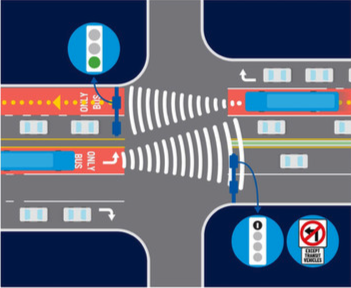
Signal Upgrades and Transit Signal Priority. Source: TransLink, 2026.
Queue Jumps
Queue jumps are another way to shorten the time that buses spend at intersections. They “are short dedicated transit lines or a shared turn pocket paired with a transit signal treatment that allows transit vehicles to get ahead of traffic at an intersection” (TransLink, 2026)
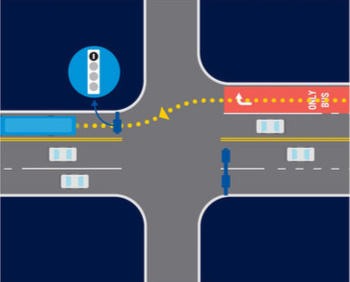
Queue Jump Design. Source: TransLink, 2026.
Some work is already being done on local roads along this route!
The City of Richmond is working on a dedicated left turn lane for buses from Westbound Alderbridge Way to southbound Garden City Road. Construction is expected in 2027.
5. Bus-Only Queensborough Bridge Onramp
The current route from 22nd Street Station to the Queensborough Bridge is indirect, via Stewardson Way—a pinch point frequently congested during rush hour. As a result, it can take more than 10 minutes just to get onto the bridge.
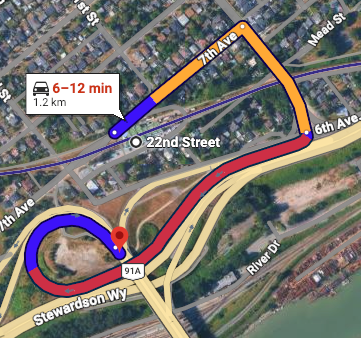
In the northbound direction, buses heading toward 22nd Street Station have a dedicated bus-only offramp.
If we can mirror this with a southbound bus-only onramp, up to 10 minutes of travel time will be cut from the 91X.
This will also benefit the 600+ other buses that make this trip on a daily basis. The significant time savings mean that millions of dollars of operations funding are not wasted on the congested, indirect routing. These savings can be re-invested into more service.
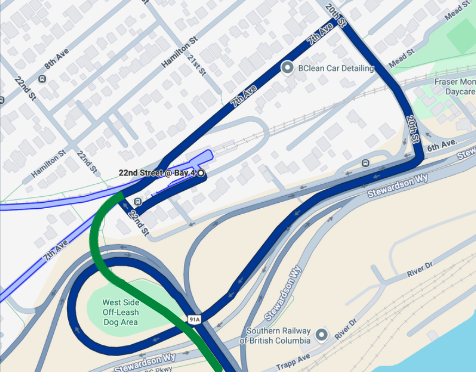
Blue: Existing route for buses heading from 22nd Street Station to the Queensborough Bridge. Green: proposed direct bus-only onramp.
How much would this all cost?
We aren’t quite qualified to put forth a cost estimate. However, we would love to have TransLink and/or the province engage in a study.
What we can say with confidence is that the 91X will have a transformative impact at a relatively low cost. It may be one of the highest bang-for-buck projects we have.
Bus-on-shoulder lanes recently added to Highway 99 in Delta cost $1.52 million per kilometre. That’s just 0.41% of the per-kilometre cost of the Surrey-Langley SkyTrain ($375 million).
Metering, transit signal priority, and queue jumps, when compared to SkyTrain infrastructure, are significantly more affordable and can be implemented in a matter of months, not decades.
The most expensive part of this project would be the onramp from the 22nd Street Station bus exchange to the Queensborough Bridge. But building a short, narrow highway overpass should be simple for MOTT.
So why isn’t this being done?
TransLink already has included express regional buses connecting Richmond-Brighouse and 22nd Street Station via Highway 91 in its Access for Everyone Plan, approved in 2022. But without funding and committed support from the BC Government, it will remain just a plan.
The Movement team has been meeting with elected officials from Richmond to Surrey, and even Langley City, at all levels of government, to bring this issue to the forefront.
Transit riders are calling on the BC Government, TransLink, and Richmond to start work on the transit priority measures and to fully fund this new route.
How can I help?
The system we have today is insufficient and holding families and businesses back. Luckily, we know what should be done and who has the power to get it done.
The Mayors Council sets the priorities for TransLink investments, and the BC Government is responsible for funding transit service expansions and highways.
This month, you have two opportunities to make a difference!
Municipal elections are on Saturday, October 17 and the Provincial general election is the week after, on Saturday, October 24.
If you get a chance to talk to candidates trying to earn your vote, share your experience making east-west regional trips from Richmond and ask them to push for 91X if elected.
We need those who can make this possible to hear our call. Movement has launched a petition calling on TransLink, the BC Government, and Mayors Council to make this happen.
Media Contacts
Er Jun Ma
Organizer
erjun.ma@movementyvr.ca