
It’s double election season in British Columbia, with voters heading to the polls to elect not only their municipal governments, but also their provincial government too! But municipal comes first, and in Vancouver, this means voting for a mayor and councillors to form city council.
We’ve asked candidates to sign our Transit Hero Pledge (follow the link to see who has signed on). But we also wanted to summarize how this council has voted on transit-related matters.
So how did the previous council vote on transit-related motions? Inspired by our friends at Vision Zero Vancouver, we made a report card! Similar to their methodology, we gave each transit motion an impact multiplier and awarded points based on how each party voted. Here are the scores, with some explanations for each vote below:
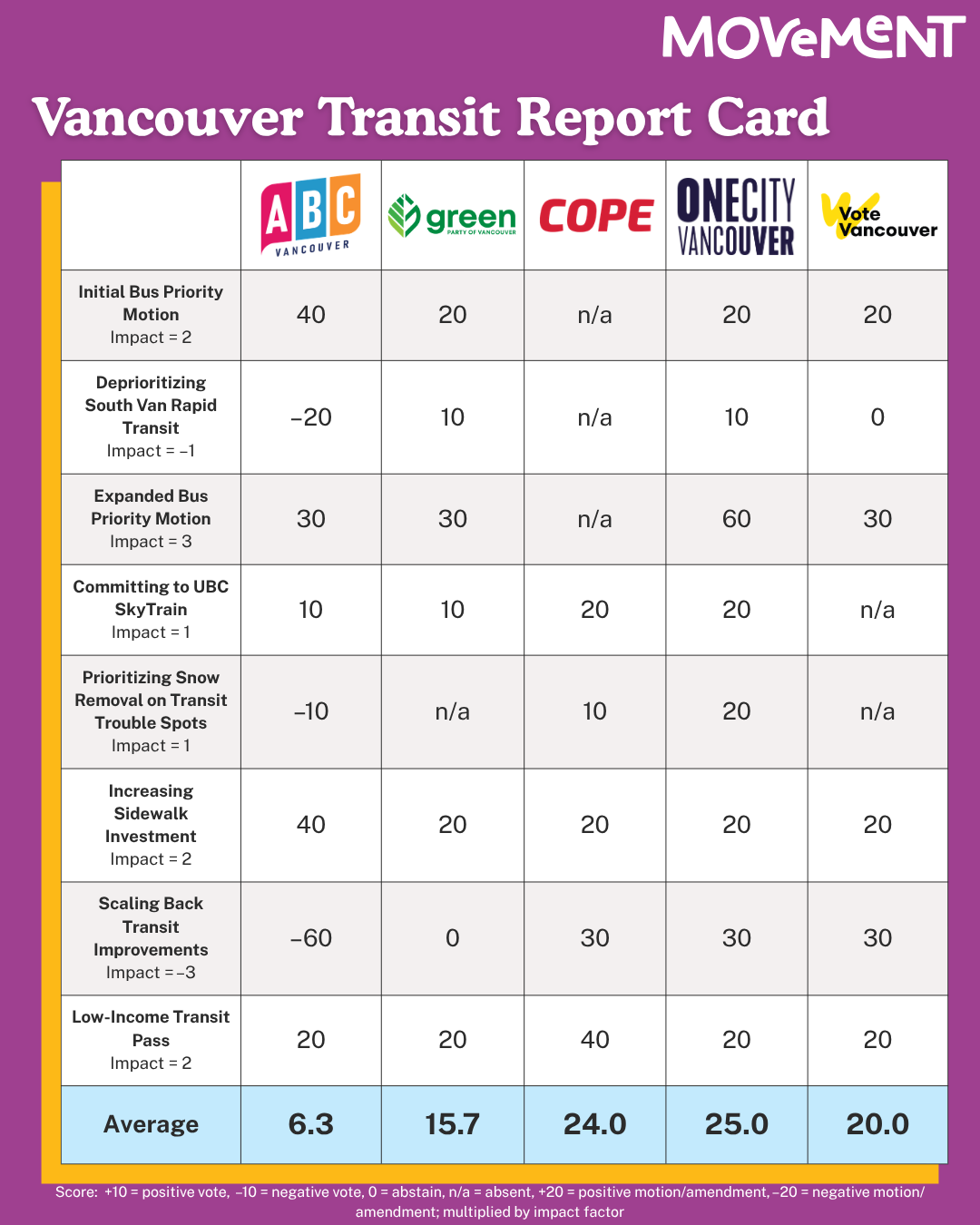
Initial Bus Priority Motion (2023) – Passed
ABC councillor Sarah Kirby-Yung brought forward this motion to urgently improve bus speed and reliability by at least 10% on four primary corridors: Hastings St, Kingsway, 49th Avenue, and Granville St. This was supported unanimously by all parties at the time.
Deprioritizing South Vancouver Rapid Transit (2023) – Passed
Sarah Kirby-Yung’s 2023 bus priority motion also included a component that asked the Mayors’ Council to replace rapid transit planning on 41st/49th Avenue in South Vancouver with a study aimed at Hastings St instead. This was separated from the overall motion and voted on separately. ABC Vancouver councillors voted in favour, except for then-ABC councillor Rebecca Bligh, who abstained. Councillors from the Greens and OneCity voted against.
Expanded Bus Priority Motion (2024) – Passed
A year after the original bus priority motion, OneCity councillor Christine Boyle tabled a second motion to reaffirm and expand the number of priority corridors from the original four. It also called on the provincial government to allow automated bus lane cameras (similar to the famous ones in New York). This was again supported unanimously by ABC Vancouver, the Greens, and OneCity.
Unfortunately, since this motion passed, progress has been slow.
Committing to UBC SkyTrain (2025) – Passed
A SkyTrain extension to the University of British Columbia once again appeared in the news last year, when OneCity councillor Lucy Maloney and COPE councillor Sean Orr brought forward a joint motion to ask the provincial government to expedite the project. Ultimately, the ball lies in the Province’s court to deliver UBCx, but at the council table, all parties present supported this motion.
Prioritizing Snow Removal on Transit Trouble Spots (2026) – Defeated
Lucy Maloney brought forward another motion in 2026, this time aimed at asking staff to work with TransLink and prioritize snow removal for areas that previously caused problems for transit buses during snowfall. This motion was defeated, with ABC Vancouver voting against, COPE voting in favour, and both the Greens and Vote Vancouver being absent.
Increasing Investment for Sidewalks (2026) – Passed
Did you know Vancouver has a 400-year backlog of sidewalk repairs? ABC Vancouver mayor Ken Sim moved a motion to increase funding from $34 million to $104 million over four years to tackle the deteriorating conditions of sidewalks and roads in the city. This was supported unanimously by all parties.
Scaling Back Transit Improvements (2026) – Passed
ABC councillor Sarah Kirby-Yung put forward a motion accepting city staff’s recommendations to:
- Not deliver a RapidBus on Marine Dr
- Not do a study looking at rapid transit (ie. SkyTrain) on the 41st/49th Avenue corridor without external funding
- Not initiate work on bus speed and reliability improvements on the additional four corridors from the 2024 bus priority motion, until the first five bus corridors are completed
This motion passed at council, with ABC Vancouver voting in support, while COPE, OneCity, and Vote Vancouver voted against. Pete Fry of the Green Party of Vancouver abstained.
Advocating for a Low-Income Transit Pass (2026) – Passed
We had a campaign pushing the provincial government to create a low-income transit pass over the summer! This was amplified by several city councils passing motions in support, including Vancouver. Sean Orr tabled Vancouver’s low-income transit pass motion, and it passed unanimously with support from all parties.